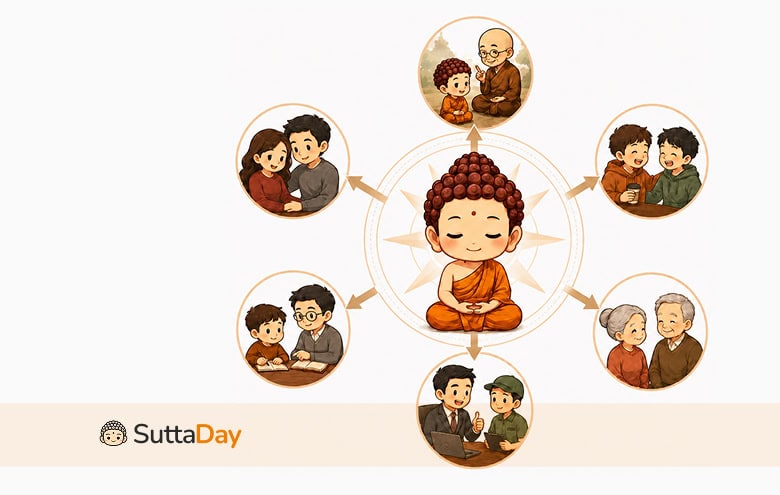
“Mother and father as the east,
Collection: Dīgha Nikāya
Teachers as the south,
Spouse and family as the west,
Friends and colleagues as the north,
Servants and workers below,
Brahmans and ascetics above;
These directions a person should honor
In order to be truly good.”
Sutta: DN 31
Summary of Sutta: DN 31
Early one morning, the Buddha sees a young householder named Sigālaka bowing towards the east, south, west, north, the ground, and the sky.
Sigālaka explains that his father asked him to honour the six directions before he died, so he continues the ritual out of respect.
The Buddha explains that the directions represent relationships. The east becomes parents and children. The south becomes teachers and students. The west becomes partners and family. The north becomes friends and colleagues. The direction below becomes employers and workers. The direction above becomes spiritual teachers and practitioners.
Each direction represents people who depend on you, and people you depend on in return.
The Six Directions in Daily Life
| Direction | Relationship |
|---|---|
| East | Parents and children |
| South | Teachers and students |
| West | Partners and family |
| North | Friends and colleagues |
| Below | Employers and workers |
| Above | Spiritual teachers and practitioners |
Who depends on you, and what do they depend on you for?
If you want to know whether your practice is changing your life, look at how people experience you.
When your child speaks, do they receive your attention? When a colleague contributes something valuable, do they receive credit? When a parent needs help, do you make time for them? When you manage people at work, do they experience fairness and support?
You might be sitting with your family when a message arrives. You glance down for a moment, another notification follows, and before long the conversation has moved on without you. Or perhaps a colleague helps solve a difficult problem at work. The project succeeds, the meeting ends, and nobody mentions their contribution.
Ask yourself:
What does this relationship need from me right now?
Practice: Cover One Direction
Choose one person from one of the six directions.
Ask yourself:
What does this person depend on me for?
The answer might be attention, honesty, encouragement, practical help, fair treatment, loyalty, or simply following through on what you’ve said you’ll do.
Then choose one action.
e.g.
- East – call a parent or spend time helping your child with something that matters to them.
- South – thank a teacher, mentor someone patiently, or put genuine effort into something you’re learning.
- West – take responsibility for a household task, put your phone away during a conversation, or make time for your partner or family.
- North – check in on a friend, give a colleague proper credit, or offer help without being asked.
- Below – support someone you supervise, show appreciation for someone’s work, or make sure people are treated fairly.
- Above – thank a spiritual teacher, attend a session you normally skip, or spend time putting a teaching into practice.
Reflection
- Did I do what I intended?
- How did this affect the relationship?
- Which direction needs attention next?
Use this practice when a relationship feels neglected, when life becomes busy and people start receiving only what is left over, or when you’re unsure where your practice belongs in everyday life.hen life becomes busy and people start receiving only what is left over, or when your practice feels disconnected from home and work.
How DN 31 Trains the Eightfold Path
Right Action
DN 31 trains Right Action by asking you to fulfil the responsibilities that come with your relationships.
Parents, partners, friends, teachers, students, employers, and workers all have obligations towards one another. Right Action becomes visible when people can rely on you to do your part.
Right Livelihood
DN 31 includes responsibilities between employers and workers because work is not separate from ethical living.
You cultivate Right Livelihood through fair treatment, honest effort, responsible leadership, and respect for the people whose work supports your livelihood.
Closing Reflection
Before today ends, think of one person who stands in one of these directions.
Choose one thing you can do for them, then follow through.
That’s how the six directions become part of everyday life.
Frequently Asked Questions
What are the Six Directions in Buddhism?
The Six Directions are a framework from DN 31 representing six important relationships: parents and children, teachers and students, partners and family, friends and colleagues, employers and workers, and spiritual teachers and practitioners.
What does it mean to honour the Six Directions?
It means fulfilling your responsibilities within those relationships through care, fairness, honesty, support, and respect.
Why did the Buddha teach the Six Directions?
The Buddha used the six directions to show that living well depends on how we treat the people around us. He connected each direction to a relationship and the responsibilities that help those relationships flourish.
How can I practise the Six Directions in everyday life?
Choose one relationship, identify what that person depends on you for, and take one practical action that supports them.
Which direction should I start with?
Start with the relationship that currently needs the most attention. Choose one person and one practical action, then follow through.
Living well begins with the people who depend on you.
Next
Go deeper within the Eightfold Path: Right Action, Right Livelihood
Explore more within the theme: Work & Livelihood