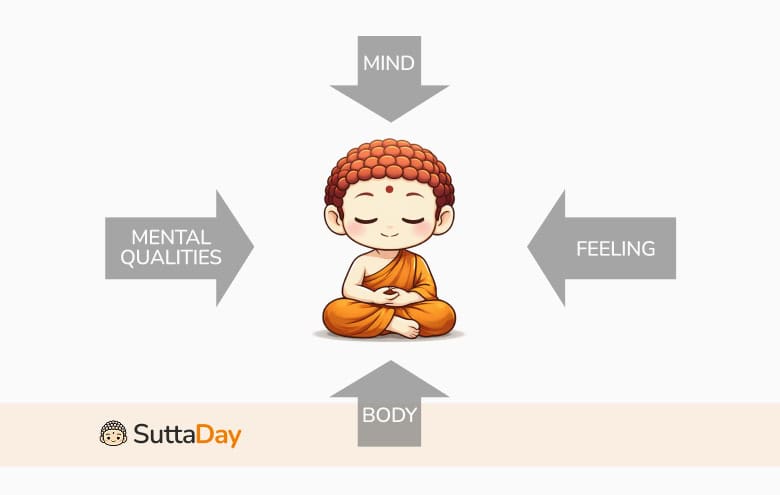
“A monk remains focused on the body, feelings, mind, and mental qualities… ardent, alert, and mindful.”
Collection: Majjhima Nikāya
Sutta: MN 10
Summary of the Sutta: MN 10
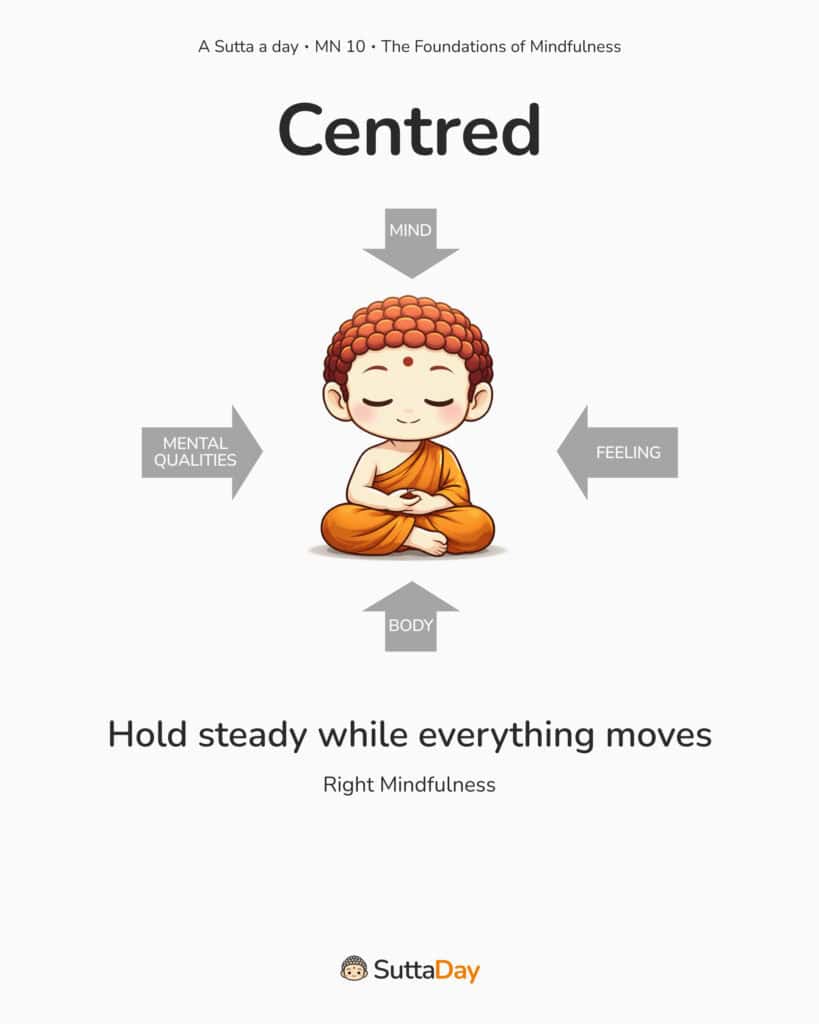
MN 10 is one of the Buddha’s clearest teachings on mindfulness practice. The sutta lays out four foundations for awareness: the body, feelings, mind, and mental qualities.
Rather than withdrawing from life, the practice is about learning to stay aware of experience while it is unfolding. The body is noticed as body, feelings as feelings, thoughts as thoughts, and mental patterns as mental patterns, without immediately getting pulled into reaction or identification.
The sutta repeats the instruction to remain “ardent, alert, and mindful,” which points toward a steady kind of awareness that keeps returning to what is actually happening in the present moment.
MN 10 is not describing a perfectly calm state where distraction never appears. It is training the ability to notice drifting earlier, return more often, and stay connected to experience instead of disappearing completely into thought, mood, or reaction.
What “Centred” Actually Means
Most people think being centred means becoming calm all the time or never getting emotionally pulled around anymore.
MN 10 points to something more practical than that.
Life still moves constantly. Plans change, moods shift, messages arrive, conversations become tense, and attention gets pulled in different directions all day long. The difference is that you begin noticing those shifts while they are happening instead of only realising afterwards that the whole day disappeared into reaction, distraction, or mental noise.
That is what mindfulness starts changing.
You feel irritation appearing before it fully becomes speech. You notice the body tightening before stress completely takes over the moment. A thought begins pulling attention away and part of you recognises the movement before getting entirely lost inside it.
Being centred does not mean life stops moving.
It means awareness stops disappearing quite so easily every time life moves.
What It Looks Like in Daily Life
You are in a meeting and somebody pushes back on your idea.
The body reacts first. Heat in the face. Tightness in the chest. The mind starts building replies before the other person has even finished speaking. Part of you is already defending, explaining, preparing.
Or maybe it is quieter than that.
You pick up your phone for a moment and twenty minutes disappears without much awareness of where attention actually went. You are sitting with family while half the mind is still trapped in work, planning tomorrow, replaying conversations, or thinking about the next thing that needs solving.
These shifts happen constantly throughout the day, and most of them are small enough that people barely notice them while they are happening.
MN 10 trains the ability to catch these movements earlier.
Not to suppress them, but to recognise them before they completely take over the moment.
The Four Foundations, Made Practical
MN 10 gives four places to return attention to while experience is unfolding.
Body
The body is often the easiest place to begin because it is already here.
The breath, the feeling of your feet on the floor, your hands resting on a table, tension in the shoulders, tightness in the jaw. Physical sensations give the mind something immediate and real to reconnect with when attention starts drifting too far into thought.
Feelings
In MN 10, feelings refer to the tone of experience: pleasant, unpleasant, or neutral.
This becomes important because reactions often begin here. Something pleasant appears and craving follows. Something unpleasant appears and resistance follows. When the feeling tone is recognised earlier, the reaction itself becomes easier to see forming.
Mind
This foundation looks at the overall state of mind itself.
Is the mind rushed, calm, irritated, restless, distracted, tired, contracted, scattered?
You are not trying to judge yourself for being in a certain state. You are learning to recognise what condition the mind is already in before it starts unconsciously shaping speech, behaviour, and decisions.
Mental qualities
These are the repeating mental patterns underneath experience.
Craving. Resistance. Restlessness. Clarity. Dullness. Calm. Defensiveness.
The more clearly these patterns are recognised, the less automatically they control the direction of the moment.
The four foundations are not really separate practices. They are different ways of staying connected to experience while it is happening.
Practice: One Anchor
Pick one simple anchor and keep returning to it throughout the day.
It could be:
- your breath
- the feeling of your feet on the ground
- your hands touching a surface
- physical tension in the body
- sounds around you
The anchor itself is not the important part.
The important part is noticing when attention has drifted, then returning without turning the drift into another problem.
You are not training perfect concentration. You are training the return.
Even ten seconds of clear awareness counts.
How MN 10 Trains the Eightfold Path
This sutta is the core training for Right Mindfulness.
Right Mindfulness
MN 10 is one of the central teachings behind Right Mindfulness because it trains awareness of experience while it is happening rather than only reflecting on it afterwards.
You begin noticing the body as body, feelings as feelings, thoughts as thoughts, and mental patterns as mental patterns. That sounds simple, but it changes a great deal because there is now a small space between experience and automatic reaction.
Instead of moving immediately from irritation to speech, or craving to action, awareness starts recognising the movement while it is unfolding.
That recognition is the beginning of mindfulness in real life.
Closing Reflections
Most people do not lose themselves in one dramatic moment.
It happens gradually through small unnoticed movements of attention repeated throughout the day. A thought pulls the mind away. A feeling takes over. A reaction forms before there has been any real awareness of what is happening.
MN 10 keeps training the return.
Not because the mind will stop drifting forever, but because each moment of recognition changes the relationship you have with experience. Over time, the body becomes easier to feel, reactions become easier to notice, and attention becomes a little less fragile in the middle of ordinary life.
That is what steadiness starts to feel like.
Frequently Asked Questions
What is MN 10 about?
MN 10 explains the four foundations of mindfulness: body, feelings, mind, and mental qualities. The sutta teaches how to stay aware of experience while it is unfolding instead of getting completely lost in reaction or distraction.
What are the four foundations of mindfulness?
The four foundations are:
- body
- feelings
- mind
- mental qualities
Together they train awareness of physical sensations, emotional tone, mental states, and repeating patterns in the mind.
How do you practise mindfulness in daily life?
A practical way to begin is by using one simple anchor such as the breath, physical sensations, or the feeling of your feet on the ground. Each time attention drifts, notice it and gently return without judging yourself for losing focus.
What are “mental qualities” in Buddhism?
In MN 10, mental qualities refer to recurring mental patterns and states such as craving, resistance, restlessness, dullness, calm, or clarity. Recognising these patterns early helps stop them from unconsciously shaping behaviour and reactions.
Does mindfulness mean stopping thoughts?
No. MN 10 does not teach suppressing thoughts or forcing the mind to become blank. The practice is about recognising thoughts, feelings, and reactions while they are happening instead of automatically disappearing into them.
Stay centred.
Next
Go deeper within Eightfold Path: Right Mindfulness
Explore more within theme: Attention, Effort