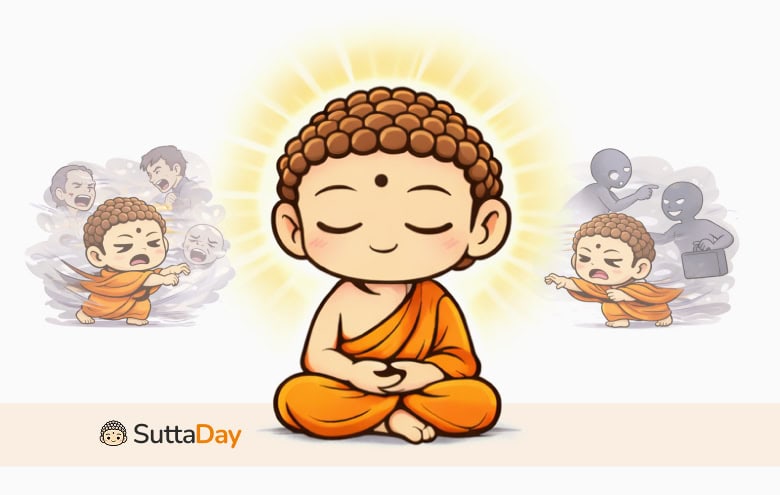
“You shouldn’t chase after the past or place expectations on the future.
What is past is left behind. The future is as yet unreached.
Whatever quality is present you clearly see right there.”
Collection: Majjhima Nikāya
Sutta: MN 131
Summary of the Sutta: MN 131
MN 131, often known as An Auspicious Day, teaches a very direct way of working with the present moment.
The Buddha warns against chasing after the past or placing expectations on the future. The past has already been left behind, and the future has not yet arrived, so neither can be directly worked with in the same way as the experience happening now.
This does not mean memory and planning have no place in life. The point is that the mind often gets pulled into replaying what has already happened or rehearsing what might happen next, until the present moment becomes something rushed through rather than clearly known.
The sutta brings attention back to what is actually here.
Whatever is present can be seen, understood, and worked with. A feeling in the body. A conversation happening now. The next clear step in front of you. The emotion that has appeared before the mind turns it into a larger story.
That is where practice happens.
What Does “No Past, No Future” Mean?
MN 131 talks about a very ordinary habit: your mind keeps leaving the present.
It goes back to what already happened and starts reworking it. Then it jumps ahead to what has not happened yet and starts rehearsing that too. Before long, part of you is in memory, part is in prediction, and the moment in front of you gets whatever attention is left.
That split is tiring.
You may be sitting at the table, walking down the street, answering a message, or trying to listen to someone, but the mind is already elsewhere. It is correcting an old conversation, preparing for a future one, replaying a mistake, or trying to control something that has not arrived.
This is what MN 131 is asking you to notice.
Not because the past and future are forbidden, but because they can so easily start running the whole moment.
What It Looks Like in Daily Life
It can happen anywhere.
You are brushing your teeth and one line from earlier comes back. Not the whole conversation, just the line that landed badly, so the mind goes over it again, adjusts it, and says it better this time.
Later, you are making lunch and tomorrow has already started. You are in the meeting before it exists, answering questions no one has asked yet, trying to get the next thing under control before it arrives.
It all looks harmless at first: thinking, planning, remembering. But your body is in one place while attention is in three, and that split slowly wears you down.
The present does not always feel ignored because anything dramatic is happening. It gets thinned out by ordinary mental movement repeated again and again throughout the day.
What It Means to “Work With What’s Present”
MN 131 brings you back to what can actually be met.
In a conversation, that may be the person in front of you rather than the argument you are preparing in your head. At work, it may be the next clear step rather than the whole project carried at once. In the middle of emotion, it may be the tightness in your chest or the heat in your face before the mind builds a full story around it.
Your mind will still remember and plan. That is part of being human.
The practice is noticing when memory or planning has stopped being useful and started taking over. Attention leaves, you notice, and you return to what can actually be touched, heard, said, felt, or done.
That is where steadiness begins.
Practice: Return to Here
When you notice your mind drifting, keep it simple.
Label it: “past” or “future.”
Then locate the body: hands, feet, seat, breath.
Take one full inhale and one full exhale, then continue with what is in front of you.
You are not trying to stay in the present forever. You are training the return.
Each return makes the present easier to find again.
How MN 131 Trains the Eightfold Path
This teaching strengthens two key parts of the Noble Eightfold Path.
Right Mindfulness
MN 131 develops Right Mindfulness by training you to notice where attention has gone while it is happening.
You begin to recognise when the mind has moved into replay, rehearsal, worry, anticipation, or regret. Without mindfulness, that drifting can run for a long time before you even realise you have left the moment in front of you.
With mindfulness, you catch it earlier.
Past.
Future.
Here.
That simple recognition gives attention somewhere to return.
Right View
MN 131 also develops Right View because it changes how you understand what can actually be worked with.
The past can be remembered, but it cannot be relived. The future can be prepared for, but it cannot be controlled from here. The only place speech happens, work gets done, emotion is felt, and wise action becomes possible is the present moment.
That view simplifies the next step.
Instead of trying to solve the whole of life in your head, the question becomes much smaller and more honest:
What is here now?
Closing Reflection
The mind often tries to live in more than one time at once.
It carries the past forward through replay, regret, nostalgia, and unfinished conversations. It pulls the future close through planning, fear, expectation, and the wish to be ready before life arrives.
MN 131 does not ask you to cut off memory or stop preparing for what matters. It asks you to notice when the mind has left the only place where anything can actually be met.
The present is rarely as dramatic as the stories around it.
But it is workable.
And sometimes that is enough.
Frequently Asked Questions
What is MN 131 about?
MN 131 teaches that clarity comes from working with what is present instead of getting lost in the past or future. The sutta encourages seeing present experience clearly as it is happening.
Does “no past, no future” mean ignoring memory and planning?
No. MN 131 does not reject memory or planning. It warns against chasing the past or placing expectations on the future in a way that pulls attention away from what can actually be worked with now.
How do you practise the present moment in Buddhism?
A practical way to practise is to notice when the mind has drifted into the past or future, label it simply, return through the body, take one breath, and continue with what is in front of you.
How does MN 131 relate to mindfulness?
MN 131 relates to mindfulness by training awareness of where attention has gone. When you notice that the mind is replaying the past or rehearsing the future, you can return to the present moment more clearly.
Why is the present moment important in Buddhism?
The present moment is where experience can actually be known and responded to. Speech, action, emotion, and understanding all happen here, so Buddhist practice returns attention to what is present rather than being carried away by replay or anticipation.
Stay here.
Next
Go deeper within Eightfold Path: Right Mindfulness, Right View
Explore more within theme: Attention