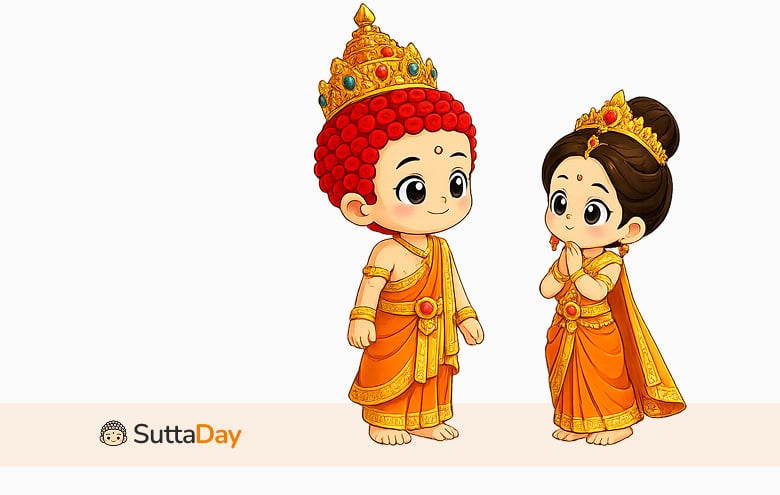
“Sire, we must be parted and separated from all we hold dear and beloved. Don’t pass away with concerns. Such concern is suffering, and it’s criticized.
Sire, you have 84,000 cities, with the royal capital of Kusāvatī foremost. Give up desire for these!”
Collection: Dīgha Nikāya
Sutta: DN 17 King Mahāsudassana
Summary of Sutta: DN 17
DN 17 is a long sutta in which the Buddha tells the story of King Mahāsudassana, a ruler with extraordinary riches, power, and splendour. The discourse explores worldly success, desire, impermanence, and the end of life. This article focuses on what DN 17 teaches about letting go in Buddhism.
King Mahāsudassana possesses unimaginable wealth. He rules over 84,000 cities, lives in 84,000 palaces, reclines on 84,000 golden couches, and enjoys every luxury the world can offer. The repeated descriptions make one thing clear: he has everything people usually spend their lives chasing.
As the king approaches death, Queen Subhaddā begs him to hold on to all that he has built. She reminds him of his cities, palaces, treasures, and possessions, urging him to keep delighting in them rather than letting them go. The king gently asks her not to speak that way. Instead, he reminds her that everything we treasure must one day be left behind and that dying with concern only brings suffering.
The Buddha closes by reflecting that all conditioned things are impermanent, unstable, and unreliable. King Mahāsudassana’s wisdom is revealed in the way he lets his kingdom go without clinging.
What Are You Afraid to Lose?
If someone asked you what you’re most afraid of losing, what would you say?
Perhaps it’s your partner, your children, your health, your work, or the future you’ve spent years building. Whatever comes to mind, it probably isn’t just something you value. It’s something you’ve come to rely on for happiness, security, or a sense of who you are.
King Mahāsudassana has more than anyone could hope for, yet the turning point of the story isn’t the kingdom he builds. As his life comes to an end, he sees that none of it can be kept and refuses to meet that moment with concern.
Take a moment to think about it: What are you afraid of losing?
The answer matters because it often points to the place where change feels hardest to accept.
Where This Shows Up
When you’re afraid of losing something, you often stop enjoying it while you still have it.
Perhaps your child is leaving home for the first time. Instead of making the most of the weeks you still have together, your thoughts keep jumping ahead to the empty bedroom, the quieter house, and how different life will feel.
Or perhaps your company announces another restructure. Nothing has happened yet, but you’ve already pictured yourself cleaning out your desk, updating your résumé, and wondering what comes next.
In both situations, the future steals your attention from the present. King Mahāsudassana accepts what cannot be kept, which frees him to appreciate what is still in front of him. His example invites you to do the same.
Practice: What Are You Afraid to Lose?
The next time you catch yourself worrying about the future, pause for a moment and ask yourself:
- What am I afraid of losing?
- If I knew I couldn’t keep this forever, how would I treat it today?
- What can I appreciate right now instead of worrying about tomorrow?
When to use it
Use this whenever you find yourself worrying about losing someone, something, or the future you’ve imagined. It gently shifts your attention from trying to control what comes next to appreciating what is already here.
How DN 17 Trains the Eightfold Path
Right View
King Mahāsudassana sees clearly that even a kingdom of 84,000 cities cannot be kept forever. Seeing life this way is the beginning of Right View. When you recognise that everything you value is subject to change, you stop looking for lasting security in things that were never permanent. You can still love your family, enjoy your work, and care for what you have, but you no longer expect them to remain unchanged forever.
Right Intention
The king’s understanding changes how he responds. He accepts that the time has come to let his kingdom go. You cultivate the same intention whenever you loosen your grip on what you cannot keep and choose appreciation over possession.
Closing Reflection
Few of us will ever rule a kingdom, but all of us have something we hope never changes.
Whatever came to mind when you asked yourself, “What am I afraid to lose?”, spend a little more time appreciating it today.
Letting go begins long before loss. It begins when you stop expecting what you love to stay exactly as it is.
Frequently Asked Questions
What does DN 17 teach about letting go?
DN 17 teaches that no amount of wealth, power, or success can be held onto forever. King Mahāsudassana’s wisdom isn’t found in the kingdom he builds, but in his willingness to leave it without clinging when the time comes.
Why am I afraid of losing the people I love?
If someone you love is a big part of your life, it’s natural to worry about losing them. DN 17 encourages you to recognise that concern without letting it overshadow the time you still have together. Appreciating someone today is more valuable than spending today fearing tomorrow.
Why does Queen Subhaddā ask the king to hold on?
Queen Subhaddā responds as many of us probably would. She reminds the king of everything he has built and encourages him to keep delighting in it. Her words represent our natural desire to hold on, while the king’s reply shows another possibility: accepting that everything dear must one day be left behind.
How can I practise letting go in everyday life?
Start with one simple question: “What am I afraid of losing?” Your answer often reveals where you’ve become attached. From there, shift your attention to how you can care for that person or part of your life more fully today, instead of trying to guarantee it will never change.
Why does the Buddha tell the story of King Mahāsudassana?
King Mahāsudassana has everything people usually spend their lives chasing. His willingness to let it all go shows that impermanence reaches every life, no matter how successful it appears.
Appreciate it while it’s here.
Next
Go deeper within Eightfold Path: Right View, Right Intention
Explore more within theme: Letting go, Fear