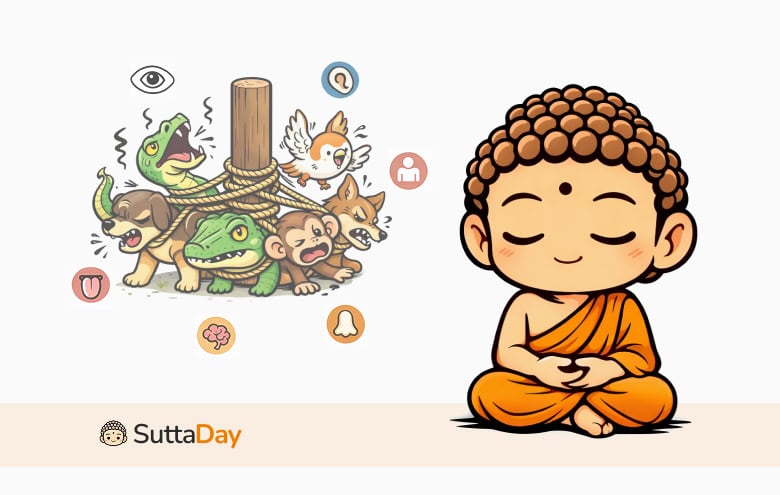
“Then those six animals, of different ranges, of different habitats, would each pull toward its own range & habitat…
And when these six animals became internally exhausted, they would stand, sit, or lie down right there next to the post or stake…
The ‘strong post or stake’ is a synonym for mindfulness immersed in the body.”
Collection: Saṁyutta Nikāya
Sutta: 35.206
Summary of the Sutta: SN 35.206
In SN 35.206, the Buddha gives a vivid simile to describe the restless movement of the mind.
He asks the listener to imagine six different animals tied together with ropes: a snake, a crocodile, a bird, a dog, a jackal, and a monkey. Each animal wants to run toward its own natural habitat. The bird tries to fly into the sky, the crocodile pulls toward the water, the dog pulls toward the village, and the monkey pulls toward the forest.
Because they are all tied together, the animals drag against one another constantly.
The Buddha explains that these six animals represent the six sense bases: eye, ear, nose, tongue, body, and mind. Each sense keeps pulling attention toward sights, sounds, smells, tastes, sensations, and thoughts.
Then the Buddha introduces the image of a strong post or stake.
If the animals are tied firmly to the post, they eventually stop dragging everything around and settle near it. The Buddha says this “strong post” is mindfulness grounded in the body.
The senses still function, but attention no longer gets completely carried away by every impulse, distraction, or reaction.
What Being “Pulled in Six Directions” Looks Like
Most people know this feeling well, even if they have never heard the simile before.
You sit down to focus on one thing, then a sound pulls attention away. A notification appears and the hand reaches for the phone before there has been any conscious decision to do it. A memory surfaces and suddenly the mind is replaying an old conversation instead of staying with what is actually happening in front of you.
The movement is constant.
A thought leads to another thought. A feeling triggers a reaction. A craving appears and attention follows it automatically. Sometimes the mind moves so quickly between stimulation, planning, worrying, remembering, and reacting that it becomes difficult to feel settled anywhere for more than a few seconds.
What makes this difficult is that it rarely feels dramatic while it is happening.
It simply feels like normal life.
That is why the simile remains so relevant now. Modern life constantly strengthens the habit of scattered attention. Notifications, noise, advertising, scrolling, messages, background stimulation, endless switching between tasks. The senses are continuously being pulled outward toward something new.
SN 35.206 asks a simple but uncomfortable question:
What happens to the mind when it is pulled around all day without any stable anchor?
What It Looks Like to Be Anchored
In tIn the simile, the animals do not disappear.
The bird still wants the sky. The crocodile still wants the water. The monkey still wants the forest. The pulling remains, but the strong post stops everything from being dragged endlessly from place to place.
That changes the feeling of the whole system.
Mindfulness works the same way.
Thoughts still appear. Sounds still interrupt. Cravings still arise. The phone still lights up. The difference is that attention becomes less automatic and less easily carried away by every impulse that appears.
You notice the pull without immediately following it.
A sound appears and awareness stays grounded in the body instead of fully chasing the distraction. A thought begins forming and part of the mind recognises it before disappearing completely into the story. Restlessness shows up, but there is enough steadiness to remain where you are for another breath instead of instantly escaping into stimulation.
This is what the Buddha means by anchoring the mind.
Not controlling the senses, but becoming less dominated by them.
Practice: Anchor Attention
When you notice the mind feeling scattered, pause for a moment and bring attention back into the body.
Feel your feet on the ground.
Feel the breath moving.
Feel your hands resting somewhere physical and real.
Then let everything else continue in the background without chasing after it.
Thoughts can still be there. Sounds can still be there. Feelings can still move. The practice is not about forcing the world to become quiet. It is about giving attention somewhere steady to return to while everything else continues moving around it.
Even a few seconds of returning matters.
That is how stability gradually develops.
How SN 35.206 Trains the Eightfold Path
Right Mindfulness
SN 35.206 strongly develops Right Mindfulness because the entire simile revolves around learning to recognise where attention is being pulled.
Without mindfulness, sights, sounds, thoughts, sensations, and impulses continuously drag the mind outward without much awareness of what is happening. Attention keeps reacting automatically to whatever stimulation appears most strongly in the moment.
Mindfulness interrupts that automatic movement.
You begin recognising:
- “This is seeing.”
- “This is hearing.”
- “This is thinking.”
- “This is craving.”
- “This is distraction.”
That recognition helps attention stay grounded instead of becoming completely absorbed in every passing impulse.
Right Effort
The sutta also develops Right Effort because staying anchored requires repeated returning.
The mind drifts, then returns.
It gets distracted, then steadies again.
It follows a thought, notices, and comes back.
This returning is not failure. It is the training itself.
Over time, the repeated effort to come back strengthens stability and makes attention less fragile in the middle of ordinary daily life.
Closing Reflection
Most people assume distraction is simply the price of modern life.
SN 35.206 asks you to look more carefully at what constant distraction is actually doing to the mind over time.
When attention is endlessly pulled outward, the mind starts losing its ability to settle anywhere fully. Experience becomes fragmented, reactions become quicker, and even simple moments of stillness can start feeling uncomfortable or unfamiliar.
That is why the Buddha compares mindfulness to a strong post driven firmly into the ground.
The world continues pulling in many directions, but awareness no longer has to follow every movement automatically.
Over time, the mind learns how to stay.
Frequently Asked Questions
What is the Simile of the Six Animals?
The Simile of the Six Animals from SN 35.206 describes how the senses pull the mind in different directions. The Buddha compares the six sense bases to six animals tied together, each trying to run toward its own preferred environment.
What do the six animals represent?
The six animals represent the six sense bases:
- eye
- ear
- nose
- tongue
- body
- mind
These are constantly pulled toward sights, sounds, smells, tastes, sensations, and thoughts.
What is the “strong post” in the simile?
The Buddha explains that the strong post or stake represents mindfulness grounded in the body. It acts as a stable anchor that prevents attention from being completely dragged around by every distraction or impulse.
How do you apply SN 35.206 in daily life?
A practical way to apply the teaching is by repeatedly returning attention to a stable anchor such as the breath, physical sensations, or the body whenever the mind becomes scattered or overstimulated.
Does Buddhism teach suppressing the senses?
No. SN 35.206 does not teach eliminating sights, sounds, thoughts, or feelings. The practice is about becoming less controlled by them so attention is not constantly pulled around automatically.
Stay anchored.
Next
Go deeper within Eightfold Path: Right Mindfulness, Right Effort
Explore more within theme: Attention, Effort