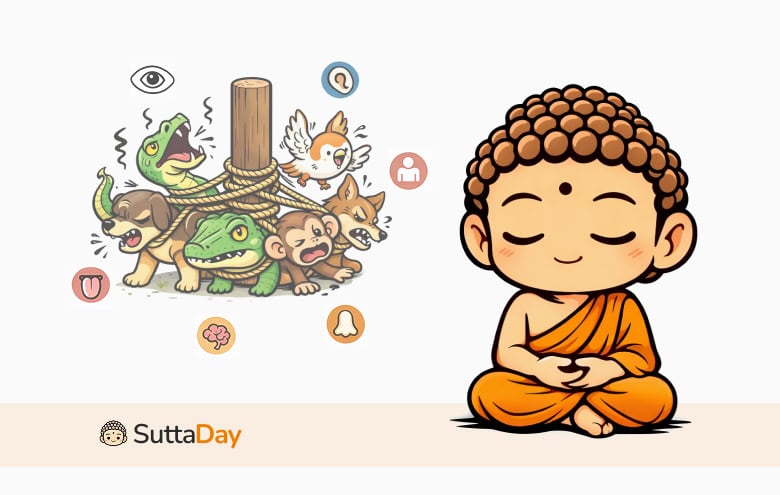
“Suppose a man were to tie together six animals… each wanting to go its own way…
They would pull and strain against one another.But if they were tied to a strong post, they would settle and come under control.”
Collection: Saṁyutta Nikāya
Sutta: 35.206
What Is the Simile of the Six Animals?
Imagine trying to walk six dogs at once, each obsessed with a different smell. That’s the simile, and that’s what the Buddha is pointing at in this sutta.
The animals represent the six sense bases: eye, ear, nose, tongue, body, and mind. Each pulls attention toward its object – sights, sounds, smells, tastes, sensations, and thoughts.
Once you see it, you start noticing it in real time.
You’re trying to be present… but the rope keeps jerking.
You try to focus, but then…
- A sound pulls you…
- A notification pulls you…
- A thought pulls you…
- A craving pulls you…
You’re pulled in different directions before you even decide.
The teaching isn’t asking us to stop sensing… it’s asking us to notice the pull, and learn to anchor.
What Being “Pulled in Six Directions” Looks Like
This usually doesn’t feel dramatic. It feels pretty normal.
- You sit down to work → your phone pulls your attention.
- You hear a sound → your focus shifts.
- A thought appears → you follow it.
- A memory surfaces → you get lost in it.
One moment becomes five, and then five becomes an hour.
Attention keeps moving… rarely resting.
Most of the time, it doesn’t even feel like distraction. It just feels like life.
What It Looks Like to Be Anchored
In the simile, the animals are tied to a strong post.
The pulling still happens, but it stops dragging you around.
Being anchored doesn’t mean the senses disappear.
You still see, hear, and think but you’re not dragged by each impulse.
- The phone lights up → you notice it, but don’t follow it.
- A thought arises → you see it, but don’t chase it.
- A sound appears → you hear it, but stay where you are.
Attention stays grounded and not pulled in six directions.
Practice: Anchor Attention
When you feel scattered:
- Pause.
- Bring attention to one place:
- Your breath / your body / the feeling of sitting etc
- Let everything else be there, but don’t follow it.
- Just stay, even for a few seconds.
That’s your anchor.
How SN 35.206 Trains the Eightfold Path
This teaching develops key parts of the Eightfold Path.
Right Mindfulness
Right Mindfulness keeps your attention grounded.
You notice:
- “This is seeing.”
- “This is hearing.”
- “This is thinking.”
Without mindfulness, each sense pulls you away.
With it, you stay steady. You experience it, without getting carried off.
Right Effort
Right Effort keeps bringing your attention back, again and again.
You notice when your mind has wandered, you return it, then you steady it.
Most of the work is simply returning… Not perfectly, but repeatedly, and that’s how stability builds.
Why This Teaching Matters Now
Modern life pulls in more than six directions.
- Notifications.
- Messages.
- Noise.
- Endless input.
Your attention is constantly divided.
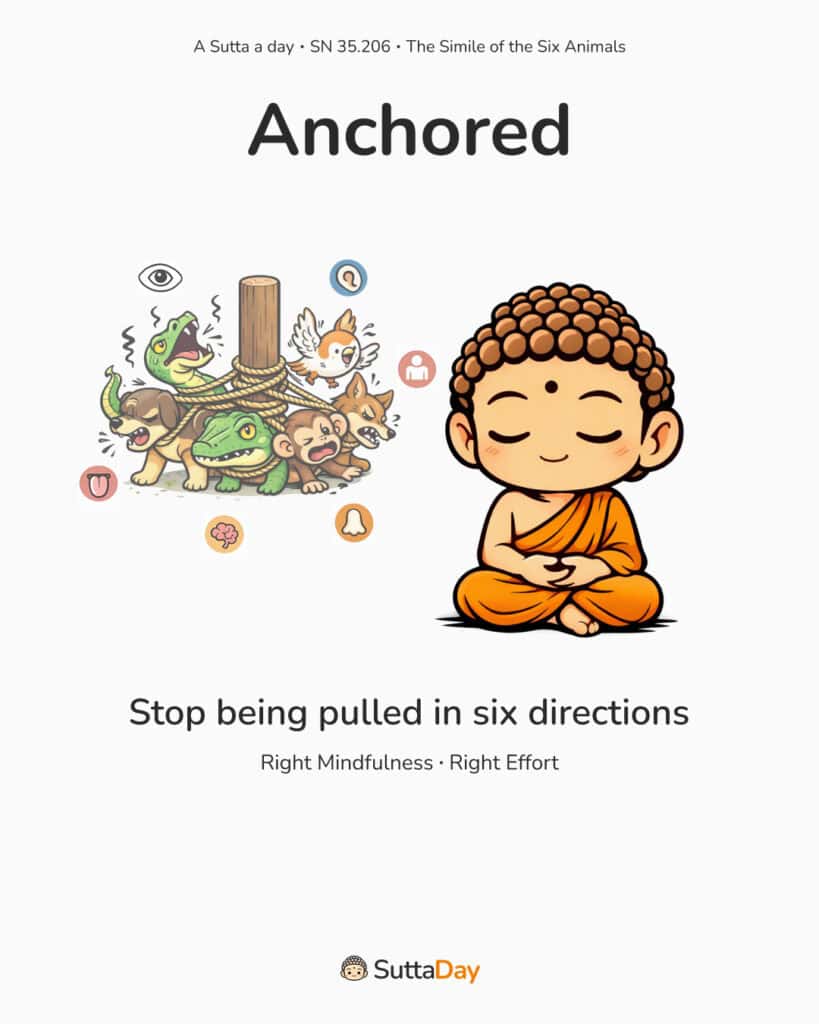
SN 35.206 points to something simple: Anchor your mind.
When your attention is anchored, your experience becomes clearer.
When it isn’t, everything feels scattered.
In Summary
SN 35.206 teaches that the untrained mind is pulled in many directions by the senses.
Without grounding, attention becomes scattered and restless.
By anchoring attention, you cultivate Right Mindfulness and Right Effort within the Eightfold Path.
Anchor your mind and let everything else move.
Frequently Asked Questions
What is the Simile of the Six Animals?
It’s a teaching showing how the senses pull the mind in different directions, creating restlessness and distraction.
What do the six animals represent?
They represent the six sense bases: eye, ear, nose, tongue, body, and mind. These pull toward sights, sounds, smells, tastes, sensations, and thoughts.
What is the “post” in the simile?
The post represents a stable anchor, often the body or mindfulness, that keeps attention grounded.
How do you apply this in daily life?
By repeatedly bringing attention back to a steady anchor (like the breath or body) instead of following every distraction.
Stay anchored.