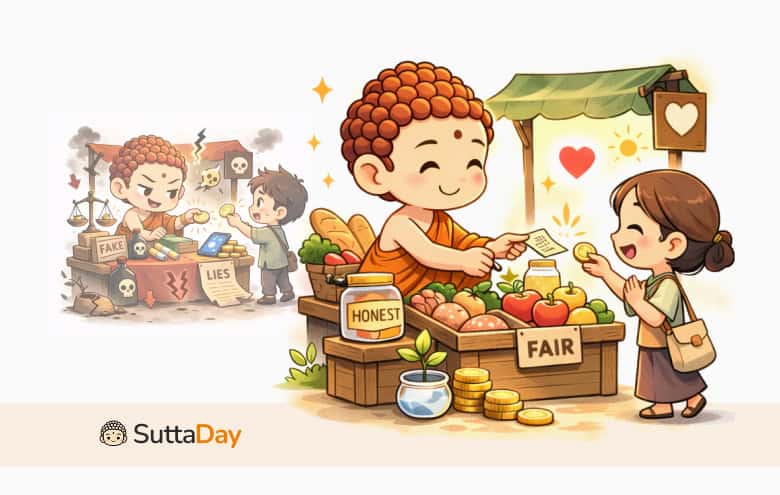
“A lay follower should not engage in five types of business. Which five? Business in weapons, business in human beings, business in meat, business in intoxicants, and business in poison.”
Collection: Aṅguttara Nikāya
Sutta: 5.177
Summary of the Sutta: AN 5.177
In AN 5.177, the Buddha gives direct guidance on the kinds of livelihood a lay follower should avoid. He names five types of business specifically: trading in weapons, human beings, meat, intoxicants, and poison.
The teaching is unusually concrete. Instead of speaking generally about “bad work” or “unwholesome behaviour,” the sutta points directly at forms of livelihood where harm is built into the work itself.
The point is not that every job must be spiritually perfect or morally pure. The Buddha is asking a simpler and more practical question than that:
What does your work produce in the world?
Does it protect life, support wellbeing, and reduce suffering, or does it depend on harm, addiction, exploitation, fear, or destruction in order to succeed?
That is the centre of Right Livelihood.
What Wrong Livelihood Looks Like
Some forms of harmful work are obvious. AN 5.177 names trades where damage is directly tied to the business itself.
- Weapons involve work built around injury, violence, or killing.
- Human beings refers to exploitation, coercion, trafficking, or treating people as products instead of human beings.
- Intoxicants involve profiting from addiction and dependency.
- Poison refers to substances designed to harm or that predictably cause harm when used as intended.
The teaching becomes more complicated once you move into ordinary modern work, because harm often appears in quieter and more socially acceptable forms.
A company may not sell poison directly, yet still profit by increasing dependency, confusion, compulsive behaviour, or pressure. Harm can hide behind respectable titles, clean branding, growth targets, or phrases like engagement and optimisation.
You can see this in products deliberately designed to keep people compulsively scrolling, gambling systems built around addiction loops, manipulative upsells, misleading sales tactics, or workplace cultures where people are squeezed until burnout becomes normal.
Most people are not waking up trying to harm others through their work. The difficulty is that harmful systems can slowly start feeling ordinary when they are tied to career growth, money, targets, or status.
That is why AN 5.177 remains uncomfortable and relevant. The sutta keeps returning the attention to impact rather than appearances.
Where Most Work Actually Sits
Most jobs are not completely pure or completely harmful.
For most jobs, the pressure shows up in smaller decisions inside normal-looking work.
A lot of modern harm doesn’t look extreme. It looks like a normal app or a normal financial product. The damage is in how the incentives work.
For example:
- Gambling-like mechanics that keep people chasing the next hit: streaks, variable rewards, loot boxes
- Payday-style traps that profit from fees and penalties when people are already struggling
- Predatory upsells that hide the real price or push people into plans they don’t need
- Dark patterns that make it hard to cancel, hard to opt out, or easy to agree by mistake
And then there are the everyday workplace versions:
Maybe you’re in sales and you’re asked to smooth the truth.
Maybe you’re in product and you’re nudged to optimise for compulsion instead of benefit.
Maybe you’re in management and “results” quietly means squeezing people.
Maybe you’re in finance and the numbers look fine, but the incentives don’t.
Nothing in isolation feels huge, but a pattern forms.
So the question shifts from “Is this job allowed?” to something more useful:
Who does this help?
Who does this harm?
What does this train in me?
If it leaves people more confused, more dependent, more pressured, or more exploited, it’s worth taking seriously, even if it’s legal and normal.
What It Means to “Be of Benefit”
Right Livelihood is not only about avoiding obvious harm. It is also about contribution.
A simple test is: when someone uses what you make or do, are they better off?
That can mean your work helps people:
- understand something clearly
- stay safe and well
- solve a real problem
- save time without creating new stress
- make a good decision without being manipulated
It doesn’t have to be heroic. It can be ordinary and clean.
Examples of work that is usually aligned with “be of benefit”:
- a teacher who explains things clearly
- a nurse, carer, or therapist helping people heal
- a shopkeeper who deals honestly
- a builder who does the job properly instead of cutting corners
- a designer who reduces friction without tricking attention
- a manager who protects people from unnecessary pressure
- a tradesperson who takes pride in safe, solid work
The point is not perfection. It is direction. You are trying to make your living in a way that helps more than it harms.
Practice: Check the Impact
At the end of the day, take one minute and trace the impact.
What did your work set in motion today?
- Did it help someone, or mislead them?
- Did it reduce stress, or add pressure?
- Did it support clarity, or feed dependence?
- Did it leave someone better off?
You won’t always have a perfect answer. That’s fine… just be honest about the direction, then adjust one thing tomorrow.
Make it a small thing you can actually do:
- say the true thing you were tempted to soften
- remove one manipulative nudge
- reduce one unnecessary pressure you pass on
- make the next step clearer for someone else
That’s practice. It’s how Right Livelihood becomes real.
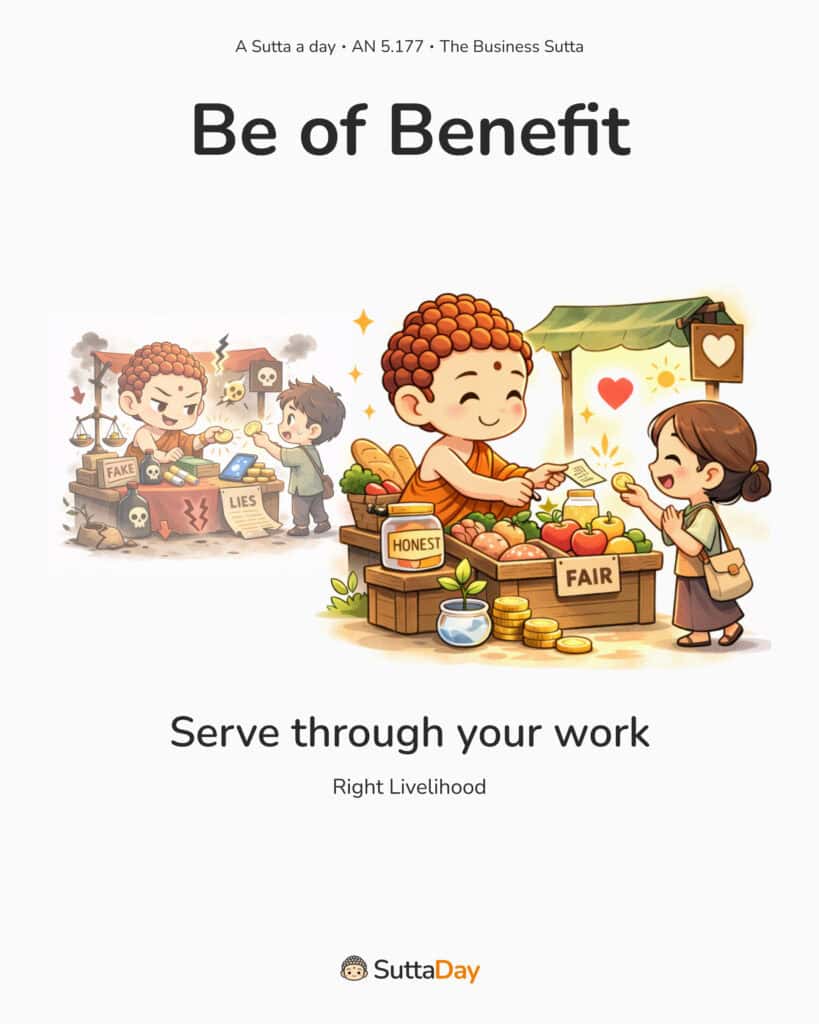
How AN 5.177 Trains the Eightfold Path
This teaching strengthens Right Livelihood.
Right Livelihood
This sutta trains Right Livelihood by keeping the question simple.
What does your work depend on, and what does it produce?
Titles and status don’t answer that. Pay doesn’t answer it either. Impact does.
AN 5.177 makes the standard concrete by naming five trades to avoid. It’s a way of keeping your livelihood honest.
So when you look at your own work, the same test applies:
- Does it rely on harm?
- Does it spread harm?
- Does it make harm easier or more normal?
Right Livelihood is choosing work that helps more than it harms.
Closing Reflection
Work shapes more than income.
Over time it also shapes habits, priorities, relationships, speech, stress levels, and the kinds of compromises a person slowly becomes willing to accept as normal.
That is why AN 5.177 keeps returning to impact.
Most people will never find perfectly harmless work inside a complicated world, but there is still a meaningful difference between work that helps people stand more steadily in life and work that leaves them more addicted, manipulated, frightened, exhausted, or dependent than before.
Right Livelihood begins by staying honest about that difference.
Then, where possible, moving a little more toward benefit and a little less toward harm.
Frequently Asked Questions
What is Right Livelihood in Buddhism?
Right Livelihood is part of the Noble Eightfold Path. It means earning a living in ways that do not depend on harming, exploiting, or deceiving other people and that ideally contribute positively to wellbeing and society.
What is AN 5.177 about?
AN 5.177, sometimes called the Business Sutta, names five types of business the Buddha advised lay followers to avoid: weapons, human beings, meat, intoxicants, and poison. The wider teaching focuses on examining the impact of work and avoiding livelihoods built around harm.
Does Buddhism require changing careers?
Not necessarily. AN 5.177 encourages honest reflection about the effects of work. Sometimes people adjust how they work within a role, while others gradually decide to move toward work that aligns more closely with their values.
What are examples of wrong livelihood today?
Modern examples can include industries or practices built around addiction, manipulation, exploitation, predatory financial systems, trafficking, harmful weapons, deceptive marketing, or products deliberately designed to increase unhealthy dependency.
What kinds of work align with Right Livelihood?
Work that supports wellbeing, safety, honesty, education, healing, care, stability, or genuine usefulness generally aligns more closely with Right Livelihood. This can include healthcare, teaching, honest trade, skilled trades, public service, caregiving, and work that reduces suffering instead of increasing it.
Be of benefit.
Next
Go deeper within Eightfold Path: Right Livelihood
Explore more within theme: Work & Livelihood